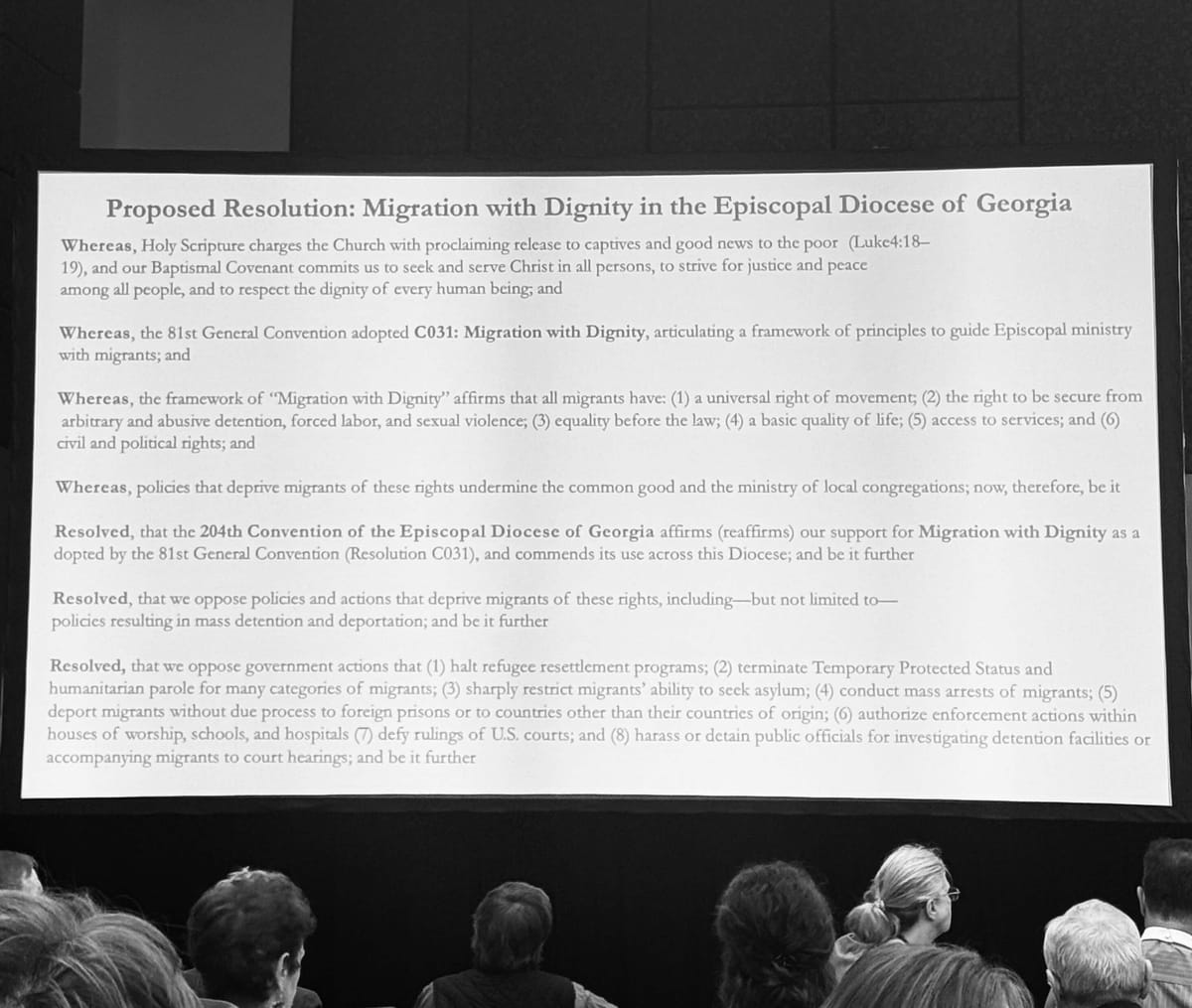
A clarion call for immigrant dignity and justice is rising from dioceses across The Episcopal Church. In recent months, 13 dioceses have passed migration-related resolutions and more dioceses plan to introduce similar resolutions at upcoming conventions.
The resolutions share similar language, affirming the Migration with Dignity resolution passed at the 81st General Convention (C031), opposing new U.S. government policies that disrespect human and constitutional rights, committing to advocacy at all levels of government, urging Church leadership to establish a Migration with Dignity Task Force and Migration with Dignity Sunday and expressing grave concern regarding 287(g) agreements that delegate federal immigration enforcement authority to local law enforcement.
The Episcopal Migration Caucus, a para-church group, celebrates the passage of these resolutions during “a state of emergency for migrants with daunting challenges facing migration ministries across the Church,” according to Martin Dickinson, Caucus Co-chair.
“The Church cannot remain silent as fellow Episcopalians and members of our communities across the U.S. are violently abducted by masked men, jailed in abhorrent conditions and removed without due process,” Dickinson said. “We are thrilled to see so many Episcopalians embracing and using their moral authority in perilous times, when so many futures and lives are at stake.”
Migration-related resolutions have passed in the Convocation of Episcopal Churches in Europe and the following dioceses, as of Dec. 15: Texas, North Carolina, Los Angeles, Minnesota, Montana, Georgia, Northern California, Ohio, Rio Grande, Chicago, Great Lakes and New Jersey.
The Diocese of the Rio Grande added clauses lamenting barriers to ministry with detained persons and expressing concern about moral injury of those employed by federal enforcement agencies and detention facilities, who may be compelled to act in ways that violate their conscience. Some dioceses also included clauses or separate resolutions designating themselves as sanctuary dioceses.
The resolution in the Diocese of Los Angeles tied ongoing immigration justice efforts to the diocese’s long-standing work of Sacred Resistance, a movement actively involved in direct actions in the face of immigration enforcement which has terrorized congregants within the diocese.
At the Los Angeles diocesan convention, which passed unanimously two resolutions calling for immigrant justice and dignity, Sacred Resistance also displayed two welcome quilts, sent in solidarity with affected immigrant communities in Los Angeles by the Welcome Quilt Project. The quilt project is led by Gale Hall, an Episcopalian in Tucson, who is also a member of the Episcopal Migration Caucus.
In the Diocese of Georgia, the Rev. Leeann Culbreath, Migration Caucus Co-chair, shared testimony about immigrant detention:
“I know from nearly a decade of ministry in Georgia’s immigrant detention centers that the current system is fundamentally inhumane and designed to destroy dignity and well-being. Private corporations run them, funded by our tax dollars. They turn a profit while detained persons work inside the facility for $1-4 dollars per day, not hour, to supplement their meager meals, call loved ones or purchase a cup to drink water.”
The diocesan resolutions passed this year also commit each diocese to observe Migration With Dignity Sunday, an annual day of education, prayer, and action for immigrant justice that was also called for in Resolution C031.
The caucus has designated February 8 as Migration With Dignity Sunday in 2026. Congregations are encouraged to take some action of migrant solidarity on that date or another Sunday in Epiphany, whether through liturgical materials in Sunday worship, educational programming, organizing a vigil service in the community or making Welcome Quilt squares for the Welcome Quilt Project. Resources for MWD Sunday worship, formation and action can be found here.
“In Los Angeles, we will observe Migration with Dignity Sunday with special urgency and poignancy. Our government has made our community a focal point for its cruel, racist roundups of immigrant workers and their families. This new tradition will give our missions and parishes an opportunity to acknowledge the current crisis while lifting up the orthodox gospel virtue of treating the stranger with dignity,” said Bishop John H. Taylor.
In a pastoral letter in August, Bishop Paula Clark (Chicago) stated,
“Anxiety and apprehension are rampant in our communities, especially those of people of color, who are affected by these threats. People are afraid to go to church, the grocery store, or even to work due to the aggressive presence of U.S. Immigration and Customs Enforcement (ICE) in Chicago and surrounding communities. This is not merely about immigration—it is about justice, dignity, and the soul of our diocese. Scripture reminds us of the Samaritan who, though marginalized, stopped to care for a wounded stranger (Luke 10:25–37). And as Dr. King wrote, ‘Whatever affects one directly, affects all indirectly.’ These injustices affect us all.”