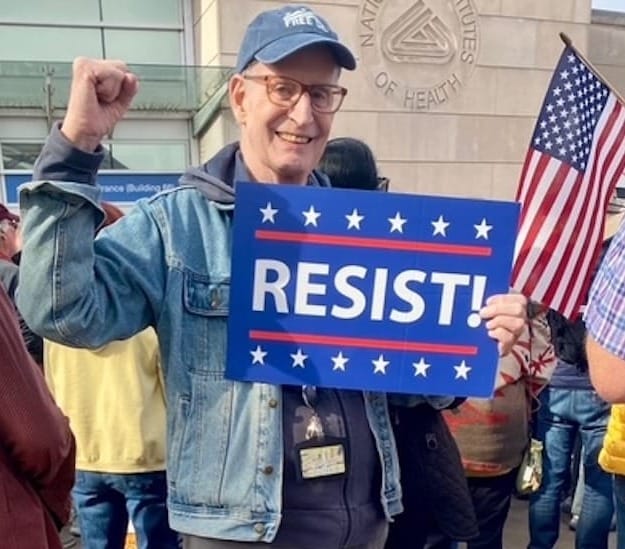
By Martin Dickinson, Caucus Co-chair
Compassionate God, as you hear the cry of every suffering creature, so hear the groans of our suffering nation. Pierce the hearts of those who sit in the halls of power. Thwart the designs of tyrants who sow division, foster fear and erode our civil rights, and who persecute and oppress the least among us. Empower us to speak when many are silent, and to resist in thought, word and deed in the name of Christ, the Prince of Peace. Amen
(“A Prayer for our Nation,” Society of Saint John the Evangelist)
Resistance is not always, nor is it forever. But sometimes we, as followers of Jesus and members of The Episcopal Church, are called to resist injustice and oppression. Now is such a time. Our church once wielded great influence in national decision-making according to Presiding Bishop Sean Rowe. He went on to say that now “we are known less for the powerful people in our pews than for our resistance to the rising tide of authoritarianism and Christian Nationalism emanating from Washington, D.C.”
Those of us in the Episcopal Migration Caucus are part of that resistance.
Together with many friends across the church, our special focus is on the brutal oppression of our immigrant neighbors. So why do we resist? How is it that we find ourselves in a time of resistance?
What we are up against
We resist because of what we are up against. Recently, I took an on-line liberation theology class with Vanderbilt theologian Joerg Rieger. Rieger interviewed a series of renowned liberation theologians asking the question “What are we up against?”
Those of us who seek justice for migrants are up against ruthless and unjust anti-immigrant actions by our government that have:
1. Halted refugee resettlement programs;
2. Terminated temporary protected status (TPS) and humanitarian parole for many categories of immigrants;
3. Sharply restricted immigrants’ ability to seek asylum;
4. Conducted mass arrests of migrants, many without warrants;
5. Deported migrants without due process to foreign prisons and countries other than their countries of origin;
6. Given the green light to enforcement within houses of worship, schools and hospitals;
7. Defied U.S. courts by failing to carry out their orders; and
8. Unleashed violence and death not just against immigrants themselves, but also against those protesting on their behalf.
And our government is now preparing a vast network of warehouse detention centers housing up to 10,000 migrants each. If injustice on such a grand scale does not call for resistance, what would?
Scriptural and theological foundations of resistance
We resist because we are guided by our scripture and theology. Certain New Testament passages seem to commend submission to governing authorities (Rom 13:1-7), but the wider canonical and theological tradition present a more ambivalent and dynamic posture toward political power. Our scripture and its interpretive history show a persistent conviction that resistance to unjust authority is not merely permissible but, under certain conditions, a theological imperative grounded in the character and purposes of God.
God is often portrayed in scripture as the defender of the oppressed and the adversary of tyranny. The Exodus narrative depicts God’s decisive intervention against a political regime characterized by forced labor, infanticide, and ethnic subjugation. Liberation from oppression is not incidental but intrinsic to God’s identity and action in history.
The prophets Amos, Isaiah, Jeremiah, and Micah frequently criticize rulers who distort justice, exploit the vulnerable or consolidate power at the expense of the common good. Their indictments are both moral and theological: they portray injustice as a violation of the covenantal order and contrary to the divine will:
Listen, you heads of Jacob
and rulers of the house of Israel!
Should you not know justice?—
you who hate the good and love the evil,
who tear the skin off my people
and the flesh off their bones,
who eat the flesh of my people,
flay their skin off them,
break their bones in pieces,
and chop them up like meat in a kettle,
like flesh in a caldron.
Micah 3: 1-3, NRSVU
Jesus’ proclamation of the Kingdom of God provides an implicit challenge to imperial claims of sovereignty according to theologian N.T. Wright (Jesus and the Victory of God, 202–210). His ministry consistently elevates the marginalized and confronts entrenched systems of exclusion. At the outset of his ministry, he is handed the Isaiah scroll in the Nazareth synagogue. He unrolls it to the place where it was written:
The Spirit of the Lord is upon me,
because he has anointed me
to bring good news to the poor.
He has sent me to proclaim release to the captives
and recovery of sight to the blind,
to set free those who are oppressed,
to proclaim the year of the Lord’s favor.
Lk 4:16-20
“Today this scripture has been fulfilled in your hearing,” he proclaims upon finishing the reading. And while Jesus does not advocate violent insurrection, his actions, including his symbolic disruption of the temple economy (Mt 21:12-13; Mk 11:15-16; Lk 19: 45-46; Jn 2:14-16), show a willingness to confront unjust structures.
It is true that Jesus teaches meekness and tolerance. It is also true that he was silent and non-retaliatory during his torture by Roman soldiers. But might we not view his conciliatory stance as a form of resistance? What could be more resistant than saying “my kingdom is not of this world (Jn 18:36)?” Or more resistant than his resurrection?
Fast forward to theologians Augustine and Aquinas. Augustine’s political thought, though frequently viewed as quietist, contains resources for resistance. His distinction between the city of God and the worldly city relativizes earthly authority, and his claim that unjust laws lack the force of true law provides a moral basis for disobedience. Aquinas later develops this insight, arguing that tyrannical rule may be legitimately resisted when it violates the common good.
Resistance is a major theme for modern theologian Walter Brueggemann (The Prophetic Imagination). Brueggemann treats resistance as a central thread of biblical faith in the prophetic and sabbath traditions. His writing frames resistance not as rebellion for its own sake, but as a disciplined, imaginative alternative to the dominant cultural forces that deform human life.
Now we are witnessing a new phase of U.S. history, a phase in which those dominant cultural forces foster a politics of fear. Goverenment actions fuel an atmosphere of racism and xenophobia. Sacred resistance is called for as a measured and faithful response to the present hatred. In this new phase, many groups across our church are stepping up to resist these injustices. If the conditions are not met for theologically and morally justified resistance now, when would they ever be?
The cost of not resisting
We resist because the price to pay for not resisting is too high. History shows what happens when the church fails to resist grave injustice. Recently I visited the Marais district of Paris, the city’s most important Jewish neighborhood before the 1940s. I learned that the Vichy regime adopted its own antisemitic laws even before the German occupiers pressed them to.
Jewish citizens were forced to register with the police, and they lost access to professions such as law, medicine, teaching and public service. Bakeries, tailors, and other shops on the main street, the Rue des Rosiers, were subject to “Aryanization,” meaning confiscation or forced transfer to non‑Jewish owners. Then came mass arrests by French police. Jewish residents were deported to concentration camps and murdered.
During my visit I saw many reminders of the terrible fate faced by Jews of the Marais, including a holocaust memorial and the wall of names listing 76,000 Jewish omen, women and children deported from France between 1942 and 1944.
For the most part the church did not resist these atrocities. While some individual Roman Catholic and Protestant leaders spoke out or helped Jews quietly, the institutional churches as a whole did not openly oppose Vichy’s antisemitic measures, especially in the early years. With few exceptions their stance ranged from silence and accommodation to limited, selective protest. The Roman Catholic Church did not formally apologize for its silence during the Holocaust until 1997.
During my own lifetime, in the 1950s and 60s, The Episcopal Church had a checkered history of opposing segregation. Many southern dioceses resisted integration, and many clergy and congregations remained silent or even opposed civil rights activism. While there are counter examples, as late as 1964 the General Convention House of Deputies failed to adopt a resolution calling for full integration of congregations, an end to segregated diocesan structures and explicit support for civil rights.
Thurgood Marshall, a deputy from New York, walked out of the 1964 convention in protest. Marshall, then a U.S. Court of Appeals judge, was to become the first African American Supreme Court justice in 1967. While there was support within the church in many places, and the church ultimately came to support Civil Rights, the institutional church had come late to the party. The church did not issue its first major official apology related to racial injustice until 2008 when it formally apologized for its involvement in slavery. And stained-glass windows celebrating Robert E. Lee and Stonewall Jackson were not removed from the Washington National Cathedral, where I am a congregation member, until 2017.
In contrast, The Episcopal Church today is well on its way to becoming a church of resistance to the unjust oppression of immigrants by the current U.S. administration. Thankfully, Episcopal Church leaders today speak out clearly about the injustices done to immigrants. In January 2026, 154 bishops called for immigration policies respecting the dignity of all. In 2024 the 81st General Convention adopted Resolution C031 establishing a framework for advocating for the rights, protection, and humane treatment of migrants, refugees, and asylum seekers. The resolution calls for Migration with Dignity Sunday throughout the church during the season of Epiphany, and it instructs the church to advocate for human rights in migration policies of the U.S. and internationally.
In the same vein, thirteen Episcopal Dioceses recently adopted resolutions calling for the church to embrace dignity, not hate, not mass deportation and not silence. These resolutions help assure that the church not remain silent as fellow Episcopalians and neighbors across the U.S. are violently abducted by masked men, jailed in abhorrent conditions and removed without due process.
What is sacred resistance?
Sacred resistance, a stance adopted by faith communities, calls upon the ancient traditions of our faith which recognized houses of worship as a refuge for the runaway slave, the conscientious objector, and the Central American refugee fleeing the civil wars of the 1980s. Across the church many dioceses are taking strong stands of sacred resistance in support of immigrants facing brutal arrests and immoral and unjust detention and deportation.
The Episcopal Diocese of Los Angeles, together with other faith groups has taken the path of sacred resistance. Sacred resistance honors a commitment to sanctuary and to peaceful action towards ensuring recognition of the dignity of all people. The diocese embodies faithful resistance in the public square and opens its congregations and communities to provide sanctuary for anyone targeted by government‐sanctioned scapegoating.
Led by Bishop John Harvey Taylor, the diocese responded courageously to the 2025 ICE raids in Los Angeles with public protest, interfaith organizing and pastoral advocacy, positioning itself as a visible moral voice against the raids and the brutal militarized federal response.
Likewise, the Episcopal Church in Minnesota, during the 2026 ICE and Border Patrol raids mounted public protest, clergy mobilization, pastoral guidance, and national‑level advocacy, becoming one of the most visible religious voices opposing the federal assault. And the Diocese of Chicago’s response to 2025 ICE raids helped protect immigrant congregants and resist intense federal enforcement tactics.
In my own Diocese of Washington, D.C., congregations and ministry groups have coalesced to form EMBRACE, the Episcopal Migrant Belonging, Resistance and Action Coalition. Activities of EMBRACE include immigration court watch, accompaniment of immigrants to ICE check-ins and helping them to prepare emergency plans or to meet needs for food and other supports when a family member is detained or deported. Through EMBRACE the diocese takes part in prayer vigils, advocacy and alliance building.
There are many more acts of solidarity with immigrants underway in our church. These are by no means the only ones. Over the past three years, during my travels as co-chair of the Episcopal Migration Caucus, I’ve visited the border dioceses of Arizona, Rio Grande and West Texas. I’ve witnessed firsthand outstanding immigration ministries of these dioceses at work on both sides of the U.S./Mexico border. Dedicated clergy and laity have led the church in migration ministry and inspired pro-immigrant actions of many others across the church.
Citizenship in the Kingdom of God
Resistance is not always, and resistance is not forever. But now we must resist. We resist because of what we are up against, because our scripture and theology call us to take action and because history shows the exorbitant price of not doing so.
We are citizens of the Kingdom of God, our God who is aligned with the oppressed and opposed to unjust power. Worldly authority is legitimate only insofar as it conforms to divine justice. When rulers violate this standard by commanding what God forbids and forbidding what God commands, we are not just permitted to resist, we are obligated to resist.
By resisting through speech and action, we strive to embody our baptismal covenant’s call to seek and serve Christ in all persons, to love our neighbors as we love ourselves, to strive for justice and peace among all people and to respect the dignity of every human being.
Together with the psalmist, we ask and demand of all worldly authority, including of our own government:
How long will you judge unjustly and show partiality to the wicked? Give justice to the weak and the orphan; maintain the right of the lowly and the destitute.Rescue the weak and the needy; deliver them from the hand of the wicked.
Ps 82:2-4, NRSVU